Observing the fundamental principles of Islam, especially Zakat, is a cornerstone of our faith.
Yet, a common question continues to trouble many: How do you calculate Zakat on your salary?
The confusion grows when trying to determine what qualifies as Zakatable income, how the Nisab applies to monthly earnings, and whether your savings or expenses affect the calculation. This uncertainty often leads to hesitation, stress, or even delay in fulfilling this vital act of worship.
That’s where a clear understanding of Zakat on salary becomes essential. With the right guidance, you can fulfill your obligation confidently, without confusion or guilt.
Let’s walk through the process together, step by step, so you can calculate your Zakat accurately and help those who need it most.
How to Calculate Zakat on Salary?
Here is the breakdown of steps to calculate Zakat on your salary:
1. Determine Your Annual Income: First of all, assess your total annual salary. This includes all sources of income, such as wages, bonuses, and commissions.
2. Subtract Essential Expenses: Deduct essential expenses from your annual income, such as rent, utilities, groceries, and other necessities. These are expenses required for basic living and survival.
3. Calculate Your Savings: After subtracting essential expenses from your annual income, calculate the amount of money you have saved from your salary throughout the year.
4. Assess Your Zakatable Assets: Identify any amount of Zakatable assets you may possess, such as cash savings, investments, or valuable possessions. These assets are subject to Zakat if they exceed the Nisab threshold.
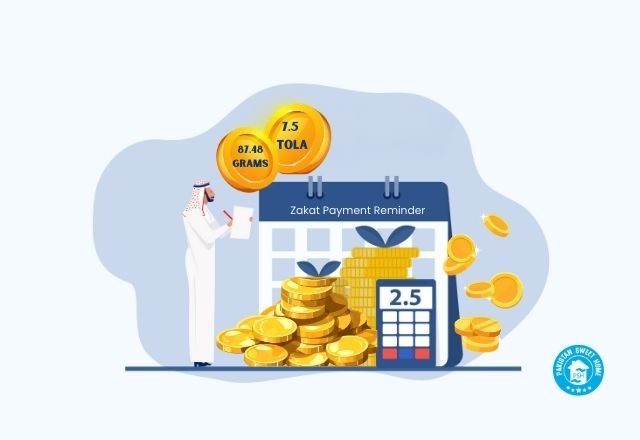
5. Determine the Zakat Nisab: The Zakat Nisab on salary follows the same standard as for other forms of wealth, which is the equivalent of 87.48 grams (7.5 tola) of gold or 612.36 grams (52.5 tola) of silver.
6. Calculate Zakat Due: Once you have determined your Zakatable assets and confirmed that they exceed the Nisab threshold, calculate the Zakat due. The percentage of zakat on salary is 2.5% of your total Zakatable assets.
Formula of Zakat on Salary
The formula to calculate Zakat on Salary is as follows:
Zakat Amount = (Annual Salary + Total Savings + Other Assets) - (Liabilities + Expenses) × 2.5%
This formula considers your annual salary, additional savings, and assets, subtracts liabilities and expenses, and then applies the 2.5% Zakat rate to the resulting net worth.
Example of Zakat on Salary
Let's understand the calculation of zakat on salary through the following example:
Annual Salary: PKR 600,000
Total Savings: PKR 200,000
Other Assets: PKR 100,000
Liabilities: PKR 50,000
Expenses: PKR 30,000
Using the formula for Zakat on Salary:
Zakat Amount = (600,000 + 200,000 + 100,000) - (50,000 + 30,000) × 2.5%
= (900,000) - (80,000) × 0.025
= 820,000 × 0.025
= PKR 20,500
So, the Zakat you needed to pay on the salary and savings would be PKR 20,500.
Zakat Scenarios for Salary Earners
Salary refers to the monthly income earned by an employee, and it falls in the category of zakatable wealth. One requirement for paying zakat on salaries and other funds is that the owner hold the funds for a full year.
Most salary earners can be categorized as follows:
Spending all the Salary
Workers who spend their entire salary and do not save any money are not required to pay Zakat. Since they haven't saved anything, Zakat is not obligatory for them. Zakat is only required on wealth held for one lunar year, which doesn't apply to their situation.
Saving Part of the Salary
Workers who save a portion of their salary fall into two categories:
a) Those who save enough to meet or exceed the Nisab by the end of the lunar year must pay Zakat on their savings.
For example, if someone earns 5 million Rupees monthly and saves 1 million Rupees per month, accumulating 12 million Rupees in savings by the year's end, they would pay Zakat on the entire 12 million Rupees.
b) Those whose savings do not meet the Nisab by the end of the lunar year are not obligated to pay Zakat.
For instance, if someone earns 5 million Rupees monthly and saves 50,000 Rupees monthly, accruing 600,000 Rupees in savings by the end of the year, they are not required to pay Zakat.
Investing Part of the Salary
Workers who invest a portion of their salary are not saving it but rather utilizing it by investing in permissible (halal) investment opportunities. If the return on investment meets the Zakat nisab of 2.5%, then Zakat is due on the gains.
Different Schools of Thought About Earned Income
The four main schools of Islamic Law have different rules for when a year passes for Zakat on earned income. However, they disagree on the reasons and have complicated rules for this, making it hard to follow.
Since the scholars didn't address salary and wages specifically, it's even more challenging for us today. Despite this, their differences show there's no clear agreement on when a year passes for earned income.
Hanbali scholars argue that Zakat on earned income should be paid immediately, comparing it to Zakat on rent, which is due immediately.
According to Abu Hanifah, a year must pass on earned income that reaches the Nisab threshold unless it's added to similar assets already owned, reaching the Nisab.
Malik's position requires a year to pass on the asset for Zakat to be due, even if the owner already has a similar asset (except for livestock that reaches its Nisab).
Al-Shafi's position is stricter regarding livestock, but also requires a year to pass on earned income.
In summary, Zakat on salary is more than a financial obligation; it’s a spiritual act of purification that connects your income to a greater purpose.
By evaluating your annual earnings, subtracting essential expenses, and checking if your savings meet the Nisab threshold, you can calculate your Zakat with clarity and confidence. The standard 2.5% rate applies only to what you truly owe, and a simple formula makes this process easier.
Whether you're spending, saving, or investing your salary, understanding your Zakat eligibility is essential. Scholars from various schools of thought offer differing views on when Zakat becomes obligatory on earned income. Understanding these fundamentals enables accurate fulfillment of Zakat obligations in line with Islamic teachings.
For children who’ve lost everything, the idea of home can feel distant—but it doesn’t have to stay that way. At Pakistan Sweet Home, we strive to create a true orphans' home, a place filled with care, comfort, and belonging. Here, every child is embraced not just with support, but with the warmth of a new family.
Invest in Orphans' Futures