Do you own gold or silver but feel uncertain about calculating and paying Zakat on them?
Many Muslims struggle to understand the rules of Zakat on gold and silver—how much to pay, when to pay, and whether all gold or silver is zakatable. Neglecting this obligation can weigh heavily on both your heart and faith.
Our guide to Zakat on gold and silver offers simple steps to help you understand and calculate your Zakat obligations effortlessly.
Let’s get started.
Formula of Zakat on Gold and Silver
If your gold and silver holdings exceed the nisab, the Zakat amount can be calculated as follows:
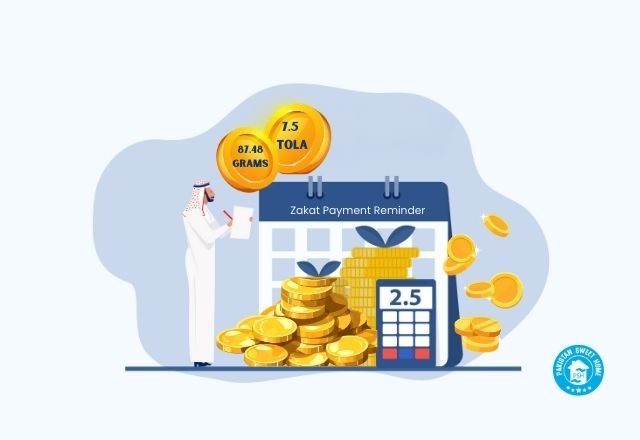
The Zakat on gold and silver is set at 2.5% of its total value, provided it meets the Nisab threshold. The Zakat nisab for gold is set at 87.48 grams (7.5 tola or 3 ounces) and for silver at 612.36 grams (52.5 tola or 21 ounces).
Note: This percentage applies whether the gold is in the form of jewelry, coins, or bars.
Here, you'll learn everything you need to know about Zakat on gold and silver, including the step-by-step calculation process.
1. Assess the Present Market Value of Gold & Silver
The initial stage in Zakat calculation involves establishing the current market value of gold and silver. This enables you to assess the total worth of your gold assets. Gold and silver prices can be checked through local jewelers, financial websites, or your country’s stock exchange.
2. Evaluate the Total Weight of Your Gold & Silver
Next, you'll need to determine the combined weight of your silver and gold assets. You can use a digital scale or visit a jeweler for accurate weighing.
3. Compute the Total Value of Your Gold & Silver
After identifying the present market price of both metals and their cumulative weight, proceed to calculate their total value. This involves multiplying the current market price of gold by the total weight of your gold.
For instance, if gold is priced at Rs. 19,370 per gram and you possess 150 grams of gold, your gold assets would amount to Rs. 2,905,500 (150 grams x Rs. 19,370 per gram).
4. Determine the Zakat Nisab on Gold & Silver
Once you have computed the total value of your gold and silver, then, you need to determine whether the total weight determined falls within the nisab. The nisab for zakat on gold and silver is the minimum amount owned before Zakat becomes obligatory. Zakat on gold and silver is determined by their value.
5. Calculate the Zakat Owed on Your Gold & Silver
Once your total value of gold and silver surpasses the Nisab, calculate and pay the Zakat owed. The Zakat is calculated at a fixed rate of 2.5% based on the total value of your gold or silver assets.
Example of Zakat Calculation on Gold and Silver
Now, let’s understand the zakat calculation on gold and silver with the following examples:
Zakat on Gold:
Suppose, You have 100 grams of gold The Zakat rate is 2.5%
If the current gold price per gram is approximately PKR 10,000, the calculation would be:
Zakat Amount = 100 g × 0.025 × PKR 10,000/g = PKR 25,000
Therefore, you need to pay PKR 25,000 as Zakat for your gold.
Zakat on Silver:
Suppose, You possess 800 grams of silver The Zakat rate remains 2.5%
Assuming the current silver price per gram is around PKR 1,000, the calculation becomes:
Zakat Amount = 800 g × 0.025 × PKR 1,000/g = PKR 20,000
Thus, you need to pay PKR 20,000 as Zakat for your silver holdings.
Note: These rates can fluctuate, so it’s essential to check the most recent prices. For accuracy and precision, you can use our updated Zakat calculator gold.
Rules for Zakat on Gold and Silver
Here are the two main conditions of zakat on gold and silver:
1. Nisab or Uruf: Zakat is due on the gold you own if it meets a certain threshold called Nisab (for gold not for usage) or Uruf (for gold for usage).
For first-time payers, Haul starts when your savings first reach the Nisab.
For ongoing payers, the cycle continues from the last date of Zakat payment.
In addition to these conditions, there are important rules governing the form and usage of gold and silver: 3. Zakat applies to all forms — coins, bars, ornaments — unless specifically exempted. 4. Women’s jewelry is commonly exempt, though scholars differ based on usage and extravagance. 5. Items made for impermissible use, such as statues, men’s jewelry, or gold dinnerware, are still subject to Zakat and considered ethically discouraged. 6. Ornamental/artistic items should be assessed at full market value, not just by weight.
Why is Zakat Obligatory on Gold and Silver?
In Islam, gold and silver are regarded as assets that increase in value, whether in the form of coins, bullion, or crafted items.
If one possesses gold at or above the nisab threshold, equivalent to 85 grams in modern times. Zakat must be paid on them due to their nature of "increase."
Note: Islam prohibits the display of items it forbids to use, especially for show-off purposes. Items made of gold or silver, such as statues or men's jewelry, are considered doubly forbidden.
Zakat on White Gold Jewelry
Zakat on white gold is calculated by considering the primary metal in the alloy, which is a mixture of different metals.
Here’s how it operates:
Composition of White Gold
White gold is a blend of gold and at least one white metal (typically nickel, silver, platinum, or palladium).
The purity of white gold is indicated in karats (similar to yellow gold).
A typical white gold composition comprises 90% gold and 10% nickel.
Calculation of Zakat on White Gold
Let’s understand the process of calculation of zakat on white gold:
Formula to Calculate Zakat on White Gold
The Zakat amount (Z) is calculated by multiplying jewelry weight (W) by the gold price (P) and nisab thresholds.
Z = W x 2.5% x P
Condition for Zakat on White Gold
If the gold content in white gold is over 50% of the total item, Zakat is calculated based on the gold nisab. White gold is treated similarly to regular gold and is subject to Zakat.
Examples of Zakat on White Gold
For an 18 Karat white gold bangle weighing 50 grams:
o The purity of this bangle is 18 karats. o The calculation for gold purity is as follows:
Gold purity = 18/24 × Total weight of the bangle In your example, the bangle weighs 50 grams.
Therefore, the gold purity is: Gold purity = (18/24) × 50 grams = 0.75 × 50 grams = 37.5 grams Hence, Zakat amount = Gold purity × Zakat percentage × price per gram of 18 Karat gold = 37.5 × 0.025 × price per gram of 18 Karat gold = 37.5 × 0.025 × 168179 = Rs 157667.8125
Note: The price of gold fluctuates, so the final calculation should be according to current prices.
Rules of Zakat on Gold and Silver
Gold and silver, regardless of form, are obligated to Zakat, except for women’s jewelry and simple silver items.
If gold or silver is possessed in forbidden forms like statuary or dinnerware, Zakat is still due on them.
Artistic pieces, including men's jewelry, are evaluated for Zakat based on their market value rather than just their weight.
Exceptions of Women’s Jewelry from Zakat
In Islam, women's jewelry is exempt from Zakat in specific amounts and proportions for these eight reasons.
Scholars debate whether Zakat is required on women’s jewelry. Some believe it's obligatory only if it leads to extravagance or applies solely to the Prophet's (PBUH) wives.
The Quran discourages hoarding gold and silver for wealth, suggesting Zakat may not apply to jewelry.
Zakat is generally not obligatory on personal belongings, including animals, tools, primary residences, cars, books, and furniture.
Zakat protects wealth assets, but jewelry's increment doesn’t count, as jewelry itself doesn’t grow. Therefore, liquidating jewelry to revert it to its original gold or silver form is required to fulfill Zakat.
Once an asset meets the Zakat condition (nisab), the obligation arises. However, when gold and silver are made into jewelry, the Zakat obligation ceases as the intention for growth is removed.
Esteemed Companions of Prophet Muhammad, including Aisha, Abdullah ibn Umar, Asma bint Abu Bakr, and Anas ibn Malik, stated that there is no Zakat on women's jewelry, including gold and silver.
According to Surah An-Nisa, verse 7, the only Zakat obligation for women regarding their jewelry may be lending it to other women.
In wrapping up, understanding Zakat on gold includes various aspects, from its calculation methods to exceptions. By grasping the formula and rules, one can fulfill this important religious obligation effectively.
Zakat on gold follows specific guidelines and conditions. It's important to understand Zakat well so you can follow the rules and help your community positively.
Pakistan Sweet Home is Asia’s well-known and largest orphanage in Islamabad, caring for children who have lost their parents. We provide them with food, education, and healthcare facilities, a safe place to live, and the love they deserve. Here, every child gets the chance to grow, learn, and build a brighter future with hope.
The Zakat on 10 tola gold in Pakistan would depend on the 2.5% of the market value of gold and the Nisab threshold set by Islamic scholars. As of 2025, the 10 tola gold price in Pakistan is RS 2829000/-.
Ali Raza holds a Master of Arts in Islamic Studies and is an expert in Islamic theology and jurisprudence. Specializing in Zakat, Sadaqah, and other Islamic donations, Ali's writings provide valuable insights into the religious and ethical aspects of charity. His work for Pakistan Sweet Homes aims to educate and inspire readers to support orphan care and charitable initiatives, making him a key contributor to the organization's mission.