Itikaf in Ramadan means isolating oneself in a mosque to dedicate all of one's time solely to the worship of Allah (SWT).
Itikaf is a spiritual retreat for Muslims, particularly during Ramadan. Typically observed during the last ten days, it allows believers to draw closer to Allah while distancing themselves from worldly distractions. It serves as a healing balm for the soul.
Let's dive into the details of Itikaf during Ramadan.
Meaning of Itikaf
Itikaf comes from the Arabic root word ‘Akafa,’ meaning ‘to adhere, cling, stick, or remain.’ It can also signify dedicating or devoting something to another for good or bad purposes. According to the Arabic language, it implies a ‘complete attachment to something.’
Itikaf Is Obligatory or Not?
The Prophet (peace be upon him) consistently practiced Itikaf, and Muslims have largely continued this tradition. All schools of Islamic jurisprudence agree that itikaf is not obligatory but a sunnah (recommended act).
According to the Hanafi school, it is considered sunnah mu’akkadah—an act regularly observed by the Prophet, while not obligatory. It is also viewed as sunnah kifayah, meaning if a few people observe it, the obligation is fulfilled for the community.
Itikaf has become a regular part of Ramadan, especially among the righteous. Aishah (RA) reported that the Prophet (PBUH) observed Itikaf during the last 10 days of Ramadan until his death. Afterward, his wives continued this practice of the last 10 days of Ramadan, Itikaf.
(Al-Bukhari and Muslim)
Purpose of Itikaf
Here are the purposes of Itikaf:
To seek Laylatul Qadr, the night more virtuous than a thousand months
To withdraw into solitude to connect with Allah and gain His blessings
To enhance Taqwa (piety and God-consciousness)
To engage in Quran recitation, Adhkaar, and other acts that elevate one’s level of Taqwa
To renounce worldly pleasures for the sake of Allah (SWT)
To maximize opportunities for prayer and offering Nawafil
To supplicate to Allah, seeking His forgiveness
To enhance the fasting experience by adhering closely to every Sunnah
Types of Itikaf
The following are the three types of Itikaf:
1. Itikaf as-Sunnah
This type of Itikaf is performed during the last ten nights of Ramadan, following the practice of the Prophet Muhammad (PBUH).
2. Itikaf an-Nafal
Itikaf an-Nafal is a voluntary act of worship that can be performed on any day outside of Ramadan or Eid days.
3. Compulsory Itikaf
Itikaf is obligatory when a person makes a vow to perform it. A vow involves promising Allah to perform Itikaf if a certain event occurs.
Ibn Abbas reported that Saad b. Ubida asked Allah's Messenger (PBUH) for a decision about a vow taken by his mother who had died before fulfilling it. Allah's Messenger (PBUH) said: Fulfill it on her behalf.
Sahih Muslim 1638a
Rules of Itikaf
The following are the rules of Itikaf that one must adhere to:
A person should remain in the mosque for the entire duration of Itikaf, except for certain necessities as mentioned in prophetic traditions. Aisha (RA) reported that when the Prophet (PBUH) observed Itikaf, he did not enter his home except to relieve himself. (Muslim)
Fasting is a fundamental requirement of Itikaf.
It is preferable to conduct Itikaf in a mosque where Jumu'ah prayers are held, and the same rules apply to both genders.
Women should seek permission from their husbands before performing I’tikaf.
If someone needs to purchase food and has no one else to do it for them, it is permissible for them to go out to buy it.
The minimum duration for Itikaf is three continuous days. It can be extended, but it cannot be less than three days.
Itikaf should be completed in the mosque where it was initiated. Therefore, leaving the mosque without a valid reason will invalidate the I’tikaf.
Itikaf in the Quran and Sunnah
Aisha (RA) narrated,
“The Messenger of Allah (PBUH) used to perform I’tikaf during the last ten days of Ramadan until he died. Then his wives used to perform I’tikaf after his death."
(Al-Bukhari and Muslim)
Allah SWT says:
“… And We entrusted Abraham and Ishmael to purify My House for those who circle it, who do Itikaf in it, and who bow and prostrate themselves in prayer.”
(Surah Baqarah:125)
Allah SWT also says:
“… Do not be intimate with your spouses while you are doing Itikaf in the mosques. These are the limits set by Allah, so do not exceed them. This is how Allah makes His revelations clear to people, so they may become mindful of Him”
(Surah Baqarah:187)
If the intention is present, itikaf can last for just a few hours. For instance, it is encouraged, though not obligatory, to be in a state of itikaf from Fajr until sunrise and from Maghrib until the end of the Isha prayer.
For both nafl and Wajib (mandatory) Itikaf, it is generally accepted that the duration is based on individual intention and can start at any time during the day or night. Therefore, if you make a vow to Allah to observe itikaf for one day, then fulfill that vow for one day; if for two days, then do so for two days, and so on.
Some scholars suggest that the minimum duration of Itikaf days is one. This opinion was reported from Abu Hanifah and shared by some Malikis.
Etiquettes of Itikaf
The etiquette of Itikaf also includes proper conduct within the mosque.
Here are some good manners to observe while in Itikaf:
Keep your voice down in the mosque, even while reciting the Quran, as loud voices can disturb other worshippers.
Limit your time in the bathroom and toilet to avoid inconveniencing others.
Avoid using bright lights while praying, as they can disturb those resting.
Move to a quieter corner if you wish to recite the Quran.
Refrain from lengthy conversations and gossip. Remember, Itikaf is about drawing closer to Allah and earning the rewards of Laylatul Qadr.
If you find yourself disliking the mosque's management or the behavior of other Mutakifs, try to ignore it and focus on your worship. Avoid engaging in personal disputes.
Take adequate rest during the day so you can effectively perform Ibadah at night.
If you experience a wet dream, promptly head to the bathroom for a shower. For sisters, if your period starts, you should discontinue Itikaf.
Those who have previously performed Itikaf should assist first-timers.
Treat the mosque’s Khadim (servant) with respect.
If someone requests help, do your best to assist them. If you're unable to, kindly decline.
Itikaf for Men
Men can choose different lengths of time for Itikaf based on their availability and preference. The practice is rooted in the Sunnah of Prophet Muhammad (PBUH), who would observe Itikaf during the last ten days of Ramadan.
Men are required to perform Itikaf in a mosque where they can participate in the five daily prayers in the congregation. It is not valid for men to observe Itikaf at home or in public spaces.
Itikaf during Ramadan, men should dedicate their time entirely to worship. This includes engaging in additional prayers (such as Tahajjud), reciting the Quran, and reflecting on their spiritual journey. They should avoid unnecessary activities or conversations that might distract them from their focus.
Itikaf for Women
Shaykh Ibn Uthaymin (20/264) issued a fatwa stating that women should perform I’tikaf in the mosque. This is based on the example of the wives of the Prophet (PBUH), who also performed I’tikaf in the mosque after seeking permission.
While it is recommended for women to pray at home, as it is considered the best place for them to offer Salah, the Prophet (PBUH) did not forbid them from observing Itikaf in the mosque.
However, based on hadith, there is no clear evidence supporting Itikaf at home, and it is considered an innovation.
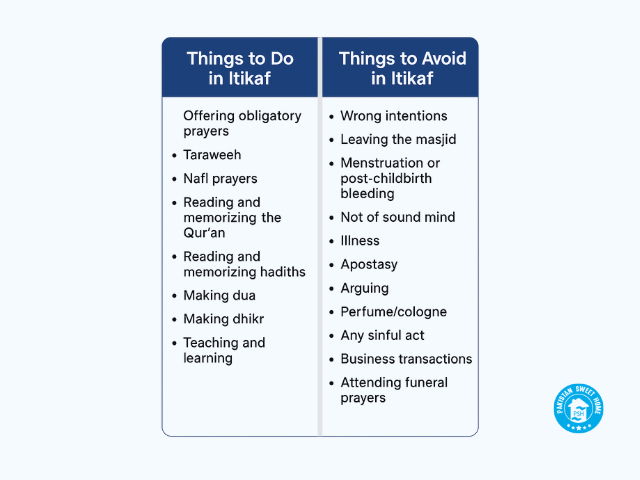
Things to Do in Itikaf
Here are the things Muslims should do in Itikaf:
Offering obligatory prayers All Muslims must perform the five daily fard (obligatory) prayers, which are naturally expected during Itikaf. It is also recommended to perform the sunnah prayers alongside the fard prayers.
Taraweeh Taraweeh is a special prayer, performed after Isha during Ramadan to earn good deeds. It consists of 8 to 20 rakah (units), depending on the Imam. By participating, one can hear or recite the entire Qur’an during Ramadan.
Nafl prayers Itikaf is an ideal time to engage in nafl (voluntary) prayers, allowing one to deepen their connection with Allah.
Reading and memorizing the Qur’an In addition to reading, studying the Tafseer (interpretation) of the Qur’an is encouraged. This is also a good time to work on memorizing verses and focusing on tajweed (proper pronunciation).
Reading and memorizing hadiths Use this time to learn and memorize sahih (authentic) hadiths. Reflect on their meanings and how to apply them in daily life.
Making dua It is important to make plenty of du’a (supplications) during itikaf. You can compile a list of du’a to learn and recite throughout the day.
Making dhikr Also known as zikr or dhikr means remembrance. Itikaf is centered around remembering Allah and increasing your taqwa (piety and consciousness of Allah).
Teaching and learning While social conversations should be limited, there is immense reward in learning and perfecting your worship. There is also great merit in teaching and helping others improve their acts of worship and religious knowledge.
Things to Avoid in Itikaf
Here are the things that break Itikaf:
Wrong intentions Itikaf is meant as a spiritual seclude to draw closer to Allah through sincere worship. If done for the sake of being seen by others—friends, family, or peers—then itikaf becomes invalid and will not be accepted.
Leaving the masjid Once the intention for itikaf is made, one must not leave the masjid without a valid reason. It is narrated that the Prophet Muhammad (peace be upon him) would allow his head to be combed by Aisha while still in the masjid.
Menstruation or post-childbirth bleeding Women who are menstruating or experiencing post-childbirth bleeding cannot perform Itikaf. If a woman starts her period during Itikaf, she must leave the mosque until she is pure again.
Not of sound mind Being under the influence of substances that impair reasoning or experiencing insanity—temporary or permanent—can invalidate Itikaf.
Illness If a person becomes ill during Itikaf, they must discontinue it, as it will no longer be valid or accepted. They should return home to recover.
Apostasy If a person renounces Islam or commits a shirk (associating partners with Allah), the Itikaf is nullified, and they must leave the mosque.
Arguing Discussing worldly matters, like politics, that may lead to arguments, should be avoided during Itikaf. Even religious discussions should be conducted calmly and respectfully. Raising one's voice or insulting others during arguments will invalidate Itikaf.
Perfume/cologne Wearing perfume or cologne with the intent of deriving or giving pleasure can nullify Itikaf. It is recommended not to wear any scent, as others may unintentionally derive pleasure from it.
Any sinful act Any sin, whether major or minor, will invalidate Itikaf. It is essential to avoid all sinful behavior during this period.
Business transactions Engaging in business during Itikaf is prohibited, as it's meant to focus solely on Allah, not on worldly matters.
Attending funeral prayers If one made the intention to attend a funeral prayer (Namaz-e-Janazah) before entering itikaf, one may attend. Otherwise, they should remain in the mosque.
In essence, Itikaf in Ramadan is about distancing oneself from worldly distractions to strengthen the connection with Allah (SWT).
Itikaf is of great importance in Ramadan through focused worship and reflection. Individuals can maximize their spiritual benefits by understanding its purpose, timings, and types, and adhering to its etiquette while avoiding distractions.
Engaging in prayer, Quran recitation, and sincere supplication allows participants to seek Allah's mercy and forgiveness. May our efforts during Itikaf be accepted and lead to renewed faith and devotion.
An orphanage center functions best when it combines comfort with opportunity, and that’s the principle behind Pakistan Sweet Home’s model. Children are not only given food and shelter but are also introduced to extracurriculars, vocational skills, and moral values. This balanced lifestyle helps them grow into capable, kind, and confident individuals.
Ali Raza holds a Master of Arts in Islamic Studies and is an expert in Islamic theology and jurisprudence. Specializing in Zakat, Sadaqah, and other Islamic donations, Ali's writings provide valuable insights into the religious and ethical aspects of charity. His work for Pakistan Sweet Homes aims to educate and inspire readers to support orphan care and charitable initiatives, making him a key contributor to the organization's mission.